Aerospace Solution Aerospace Solution

Aerospace Solution

Supporting Key Technology Breakthroughs for Fighter Jets and Aircraft

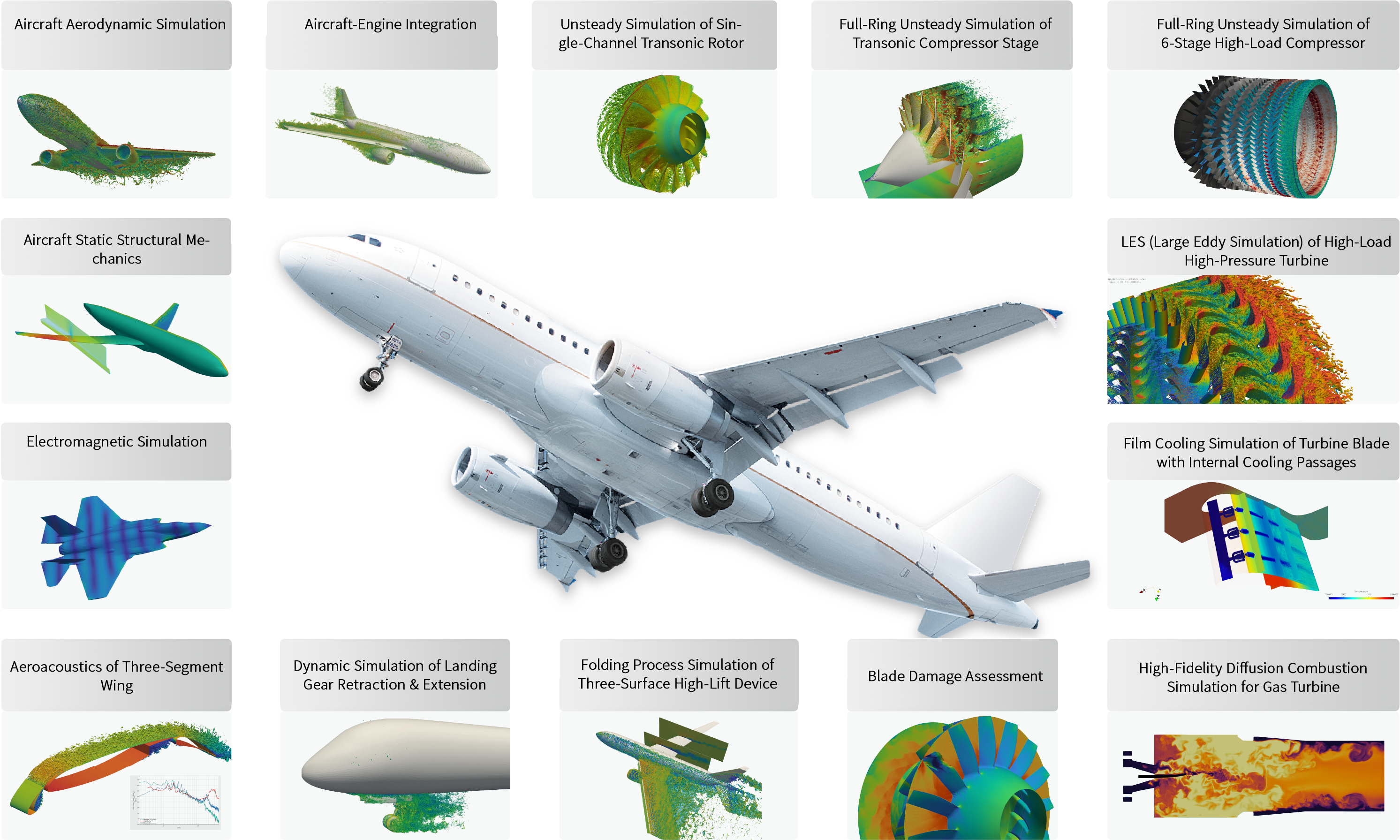
We have achieved remarkable technical advantages in complex scenarios such as large-scale multi-component full-aircraft unsteady computation, maneuvering attitude and dynamic analysis of moving components.
Industry Challenges

01

Low Simulation Resolution

Heavily reliant on turbulence models, leading to insufficient prediction accuracy of aerodynamic characteristics under high angle-of-attack and massive separation conditions
02

Prohibitive Hardware Costs

Large-scale computation relies on high-performance supercomputers, unaffordable for SMEs
03

Lack of Real Transient Data

Simulations are still dominated by RANS, making it hard to obtain unsteady data and limiting analysis and optimization of aerodynamic noise, flow-induced vibration and other issues
04

Difficulties in Transient Simulation

Complex motions (such as weapon bay release on fighter jets, airliner landing gear retraction) suffer from poor mesh quality and convergence issues
05

Inadequate Computing Capacity

Unable to run system-level multi-scale full-aircraft computation; performance for processing complex data and simulating multi-dimensional interactions fails to meet practical requirements

Solution Overview

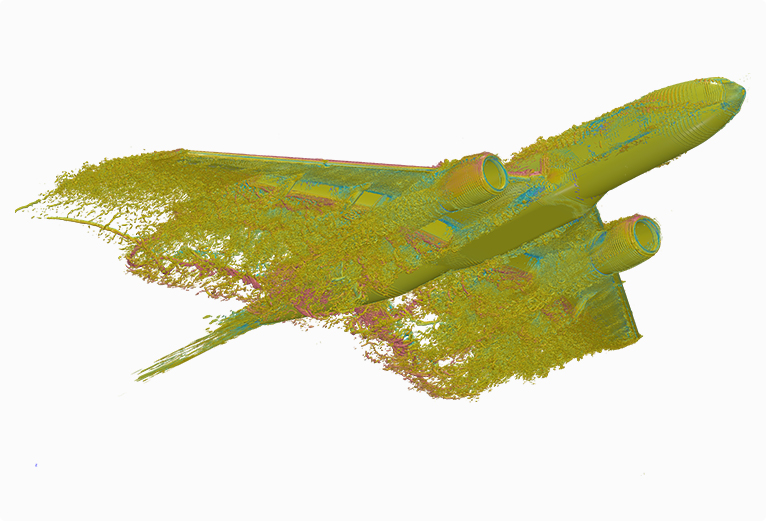
We have formed prominent technical advantages in complex scenarios including large-scale multi-component full-aircraft unsteady simulation, maneuver attitude and dynamic analysis of moving components, supporting key technology breakthroughs for sixth-generation fighters, hypersonic vehicles and other cutting-edge equipment. Meanwhile, in traditional aerodynamic performance evaluation, our solution achieves performance comparable to mainstream commercial software.

航空航天工业仿真解决方案介绍

Solution Advantages

High-Resolution Discretization for Complex Flow Capture

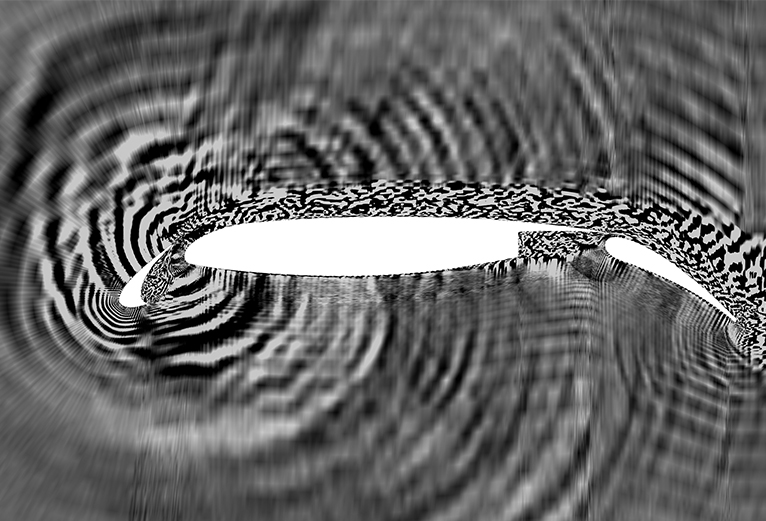
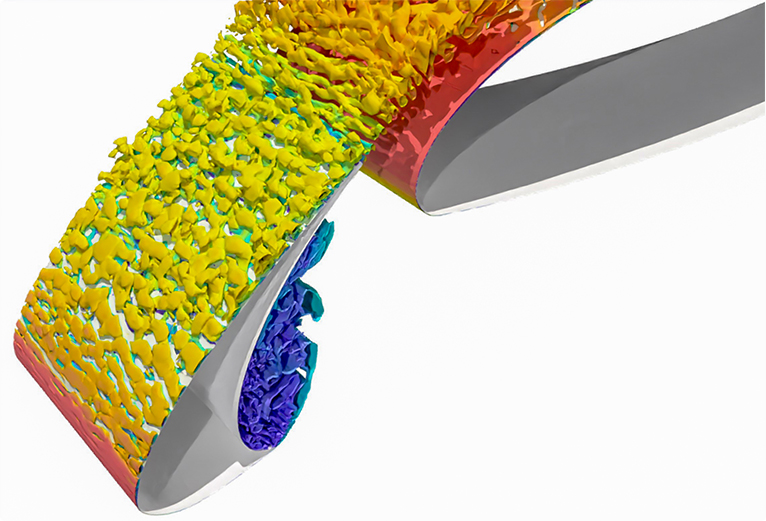
Adopts the technical combination of Turbulence-Model-Free Large Eddy Simulation (LES) + fully hexahedral mesh. 4th-order and above high-resolution spatial discretization (finite element/finite volume method) reduces numerical dissipation and directly resolves large-scale vortices without RANS turbulence model assumptions. It precisely captures complex flows such as shock waves and boundary layer separation under high angle-of-attack and massive separation conditions.

High-Resolution Discretization for Complex Flow Capture

Dual-Drive: Architecture & Technology

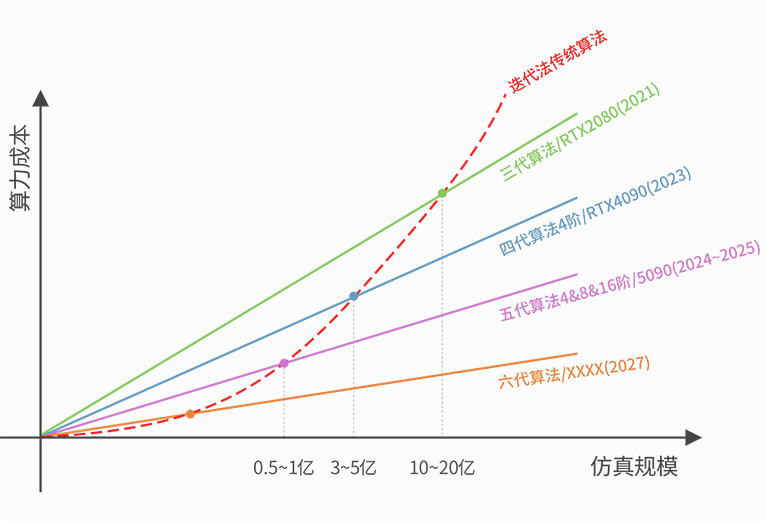
Built on the "Overset Mesh + Fully Asynchronous Computing" architecture, the simulation capability extends to billions of solving points with computation scaling linearly with problem size. Consumer-grade workstations can complete tasks originally requiring supercomputers. Combined with the Golden-Cross technology, consumer GPU workstations (e.g. RTX 4090) can run high-precision LES simulation, cutting hardware investment down to 1/100 of traditional supercomputing.

Dual-Drive: Architecture & Technology

Precise Transient Capture of Unsteady Flow

LES directly resolves unsteady flow and captures real transient details including pressure fluctuation and vortex shedding. It delivers engineering-decision-grade data for analysis and optimization of aerodynamic noise (e.g. landing gear / rotor noise) and flow-induced vibration (e.g. thermal fatigue of turbine blades), eliminating reliance on costly wind tunnel or physical tests.

Precise Transient Capture of Unsteady Flow

Dual Technology: Overset Mesh + Full Asynchronous Computing

Overset mesh technology accurately captures transient interference between moving components (such as fighter high-angle attack maneuver, eVTOL rotor-building interference, airliner landing gear retraction) and main structures. Coupled with fully asynchronous computing model, it avoids mesh distortion and convergence difficulties seen in traditional synchronous computing and boosts efficiency for large-scale transient simulation.

Dual Technology: Overset Mesh + Full Asynchronous Computing

Space-Time Extended Kinetic Energy Conservation Algorithm Breakthrough

Based on the Space-Time Extended Kinetic Energy Conserving Flux Reconstruction Algorithm (STE-KEP-FR), it supports scaling up to billions of solving points. Computational cost grows linearly with problem scale and dimensional difference with full adaptivity without iteration. It enables system-level multi-scale coupled simulation (macro full-aircraft + micro details), such as full aero-engine computation and fluid-thermal-structure coupling for large aircraft wings.

Space-Time Extended Kinetic Energy Conservation Algorithm Breakthrough

2030 · Trillion Grid Points · Thousand-Second Simulation Ultimate Restoration · Start a New Era of Physics-AI

Copyright © 2026 Suzhou Rankyee Technology Co., Ltd.  苏ICP备2025208929号

Sitemap | Privacy Policy

Top